
When an older water heater approaches the end of its useful life, homeowners have an opportunity to reconsider how their home produces hot water. Replacing a traditional storage-tank model with another tank is still a practical option, but a tankless system may provide meaningful advantages for households that want better efficiency, more usable space, and a steadier supply of hot water.
The primary benefits of tankless water heaters come from their on-demand design. Instead of storing dozens of gallons of heated water throughout the day, a tankless unit heats water as it moves through the system. This can reduce standby energy loss and allow the equipment to continue producing hot water as long as demand remains within its rated capacity.
Tankless equipment is not automatically the best choice for every property. Installation requirements, household demand, fuel availability, maintenance expectations, and the existing plumbing system all influence whether switching makes sense. Understanding both the tankless water heater benefits and the potential limitations can help homeowners make a more informed decision.
What Is a Tankless Water Heater?
A tankless water heater, sometimes called an on-demand or instantaneous water heater, produces hot water without storing it in a large tank. When someone opens a hot-water faucet, cold water enters the unit and passes through a heat exchanger. A gas burner or electric heating element raises the water temperature before the water travels to the fixture.
Once the faucet is turned off, the heating process stops. The equipment does not continue heating a stored supply of water between uses. This operating method is the main difference between a tankless system and a conventional storage water heater.
A traditional tank water heater generally stores between 30 and 80 gallons of hot water. Its burner or heating elements cycle throughout the day to maintain the selected temperature, even when no one is actively using hot water. This stored supply makes tank models relatively simple, but it also creates standby heat loss as energy escapes through the tank and surrounding piping.
According to the ENERGY STAR overview of whole-home tankless water heaters, qualified gas tankless systems heat water only when it is needed and can provide continuous hot water when properly selected for the home.
Homeowners who want more detail about operation, sizing, maintenance, and common performance questions can also review Woodward Plumbing’s tankless water heater FAQs.
What Are the Main Benefits of Tankless Water Heaters?
The most important tankless water heater benefits are connected to energy use, hot-water availability, equipment size, and long-term ownership. The exact value of each benefit depends on the home, usage habits, installation quality, and system sizing.
1. Reduced Standby Energy Loss
A storage water heater must keep its tank warm around the clock. Even a well-insulated tank gradually loses heat, requiring the system to turn on periodically and restore the selected temperature. This happens when the home is occupied, when everyone is asleep, and even when the residents are away.
A tankless unit avoids most of this standby energy use because it does not maintain a large reservoir of hot water. Energy is primarily consumed when a fixture or appliance requests hot water.
This does not mean a tankless system uses no energy while idle. Many modern units have electronic controls, freeze-protection features, recirculation components, or other functions that may use a small amount of power. However, eliminating the need to repeatedly reheat a storage tank can make tankless equipment a more energy-efficient water heater option in the right household.
2. Potentially Lower Water-Heating Costs
Reduced standby loss can translate into lower monthly energy use. Actual savings vary considerably based on the number of occupants, daily hot-water demand, fuel prices, incoming water temperature, equipment efficiency, and the performance of the previous water heater.
Homes with moderate hot-water use may see a larger percentage improvement than households with very high demand. A family that takes longer showers after installing an on-demand system could also offset some of the expected savings.
ENERGY STAR provides additional context about tankless water heater efficiency and potential savings. Homeowners should treat national estimates as general guidance rather than a guaranteed prediction for a specific home.
3. A Continuous Supply of Hot Water
One of the most appealing benefits of tankless water heaters is their ability to provide continuous hot water. A storage-tank system has a limited supply. Once the tank’s heated water has been used, the household must wait while the system heats another tankful.
A properly sized tankless system does not run out of stored water because it produces hot water as needed. This can be useful for households where family members take several showers in succession or where hot-water use frequently exceeds the capacity of the existing tank.
The phrase “endless hot water” needs an important qualification: the unit must be large enough to meet the home’s flow-rate and temperature-rise requirements. A tankless unit can continue heating water for an extended period, but it cannot exceed its rated gallons per minute. Asking it to supply several showers, faucets, and appliances at once may reduce outlet temperature or water flow.
4. A Space-Saving Water Heater Design
A conventional water heater can occupy a noticeable portion of a garage, utility room, basement, mechanical closet, or laundry area. Larger tanks also require adequate clearance for installation, maintenance, ventilation, and replacement.
A tankless system is generally a compact, wall-mounted appliance. Removing a large floor-standing tank may create more usable space or make a cramped mechanical area easier to organize.
This space-saving water heater design can be particularly helpful in smaller homes, additions, accessory living spaces, remodeled utility rooms, and properties where mechanical space is limited. The unit still needs appropriate clearances, venting, piping, electrical service, and access for maintenance, so it cannot be placed anywhere without planning.
5. A Potentially Longer Service Life
Tankless water heaters can often remain in service longer than many conventional tank models when they are installed correctly and maintained according to manufacturer requirements. A traditional storage tank may eventually fail because of internal corrosion, sediment accumulation, or leakage from the tank itself.
Tankless systems do not have a large steel storage vessel that can rust through and release its contents. Many models are also designed with replaceable internal components, which may allow a technician to address individual problems without replacing the entire appliance.
Service life still depends on water quality, maintenance, usage, installation conditions, and product design. A neglected unit exposed to mineral scale or improper combustion conditions may experience premature performance problems.
6. Less Stored Water Inside the Home
A traditional water heater may hold 40, 50, or more gallons of water. When the tank or a connection fails, that stored water can escape into the surrounding area and potentially damage flooring, drywall, belongings, or nearby equipment.
A tankless water heater does not eliminate the possibility of plumbing leaks. Connections, valves, heat exchangers, condensate drains, and supply piping can still develop problems. However, the unit does not contain a full tank of stored water, which reduces the amount immediately available during a tank-related failure.
Modern systems may also be compatible with leak-detection devices and automatic shutoff controls. These features should be evaluated based on the specific product and installation rather than assumed to be included with every model.
7. More Precise Temperature Control
Many tankless water heaters use digital controls that allow the outlet temperature to be set more precisely than some older storage systems. Internal sensors monitor flow, combustion, and water temperature while the unit is operating.
Stable temperature control can improve comfort, but proper settings remain important. Water that is set too hot can create a scalding risk, while an unnecessarily high temperature can also increase energy use and scale formation.
The equipment should be configured according to manufacturer requirements and household needs. Families with young children, older adults, or residents with reduced sensitivity to heat may need additional temperature-control measures.
8. Flexible Equipment Options
Tankless water heaters are available in several configurations, including natural gas, propane, and electric models. Gas-fired systems may be offered in condensing and non-condensing designs, while electric units vary widely in power requirements and output.
This range of options gives homeowners flexibility, but fuel type should not be selected on preference alone. The home’s electrical capacity, gas service, venting route, climate, plumbing layout, and peak demand all matter.
For some households, a high-output gas model may be the most practical whole-home solution. In other properties, an electric unit may require substantial electrical upgrades. A professional evaluation can determine which technologies are compatible with the building.
Tankless Water Heater Pros and Cons at a Glance
A balanced decision requires looking beyond the benefits. Tankless equipment can solve specific problems, but it may introduce new installation and maintenance considerations.
Common Tankless Water Heater Pros
- Water is heated only when it is requested.
- Standby heat loss is reduced.
- Hot water can continue without waiting for a tank to recover.
- The wall-mounted equipment uses less floor space.
- The system does not store a large volume of water.
- Many models offer precise digital temperature controls.
- Properly maintained equipment may provide a long service life.
- High-efficiency models may reduce household water-heating energy use.
Common Tankless Water Heater Cons
- The initial installation may cost more than a basic tank replacement.
- Gas lines, venting, electrical circuits, drains, or water piping may need modification.
- The unit must be accurately sized for simultaneous demand.
- Mineral scale can affect the heat exchanger and water flow.
- Regular flushing or descaling may be necessary.
- Hot water is not truly instant at distant fixtures unless a recirculation strategy is used.
- Some homes may need more than one unit to meet unusually high demand.
- Power interruptions can prevent many tankless systems from operating.
These tankless water heater pros and cons show why the decision should be based on the individual property. A unit that performs well in a two-person household may not be appropriate for a large family using several fixtures simultaneously.
Tankless vs. Tank Water Heater: How Do They Compare?
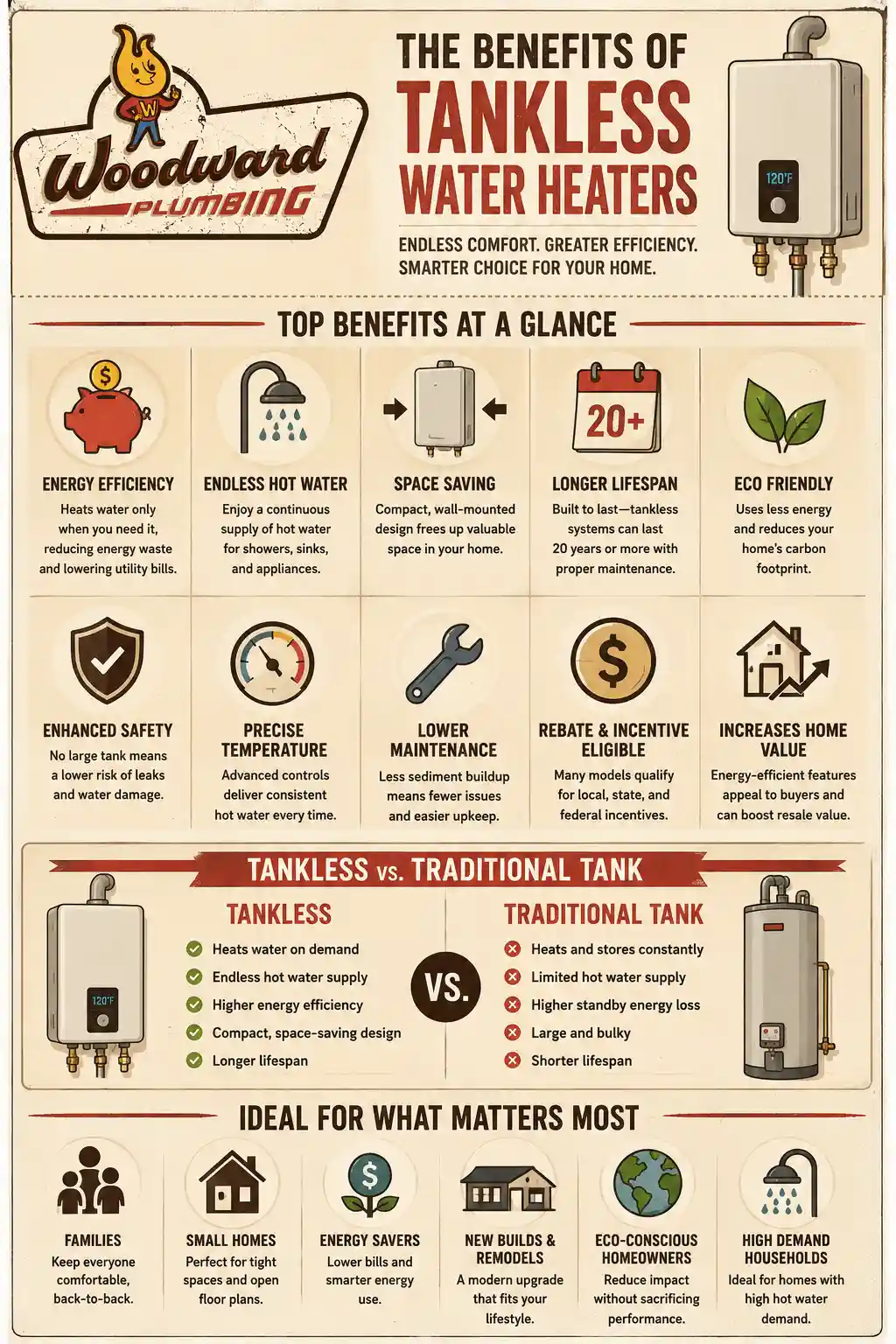
The tankless vs. tank water heater decision is not simply a choice between an outdated product and a modern one. Both designs have advantages, and either can be appropriate when selected and installed correctly.
Hot-Water Capacity
A tank water heater provides a fixed reserve. It can often support several fixtures for a limited period, but once the stored supply is depleted, recovery time is required.
A tankless model provides continuous production rather than stored capacity. Its limit is based on flow rate. As long as demand stays within the unit’s capacity, it can continue producing hot water. When demand exceeds that capacity, performance may decline.
Energy Use
Storage water heaters experience standby loss because heated water remains in the tank. Tankless equipment reduces that loss by operating primarily during active hot-water use.
Efficiency comparisons should account for the age and condition of the existing system. Replacing an inefficient older tank with a high-efficiency tank model may also produce noticeable energy savings. Tankless is not the only energy-efficient water heater option available.
Installation Complexity
Replacing a tank water heater with a similar tank model is often more straightforward because much of the existing infrastructure may already be compatible. Converting to tankless can require changes to gas capacity, venting, combustion air, condensate drainage, electrical service, or pipe placement.
These changes do not make tankless installation impractical, but they should be identified before the homeowner compares proposals or selects equipment.
Space Requirements
Tankless models generally use less floor space. Tank systems require room for the vessel and service access but may be simpler to fit into a location already designed for a conventional water heater.
Maintenance
Both types need maintenance. Tank models may require flushing, anode-rod inspection, temperature and pressure relief valve testing, and checks for corrosion or leakage.
Tankless systems commonly require flushing or descaling of the heat exchanger, inspection of filters, combustion checks, and maintenance of condensate components on condensing models. The frequency depends on the product, water conditions, and manufacturer instructions.
Replacement Decisions
Homeowners dealing with an unreliable system should first determine whether the existing water heater can be repaired economically. Woodward Plumbing’s guide to water heater repair versus replacement in Salem explains several factors that can help with that decision.
Another helpful resource covers whether a water heater failure requires complete replacement or may be connected to a repairable component.
Does Tankless Really Mean Endless Hot Water?
Tankless water heaters can provide continuous hot water, but the system’s output is not unlimited. Every unit has a maximum flow rate based partly on the required temperature rise.
Temperature rise is the difference between the incoming cold-water temperature and the desired outlet temperature. For example, when incoming water is 50 degrees Fahrenheit and the selected outlet temperature is 120 degrees, the system must produce a 70-degree temperature rise.
The greater the required temperature rise, the less water a tankless unit may be able to heat per minute. This is why the same model may have different published flow rates under different conditions.
Peak demand is equally important. A shower might use around two gallons per minute, while faucets, dishwashers, washing machines, and other fixtures add to the total. The installer should estimate which fixtures may operate at the same time rather than simply counting bedrooms or bathrooms.
For example, a household may need enough capacity to support two showers and a kitchen faucet during the morning. Another household may rarely use more than one hot-water fixture at once. Those homes should not automatically receive the same equipment.
An undersized tankless water heater can produce fluctuating temperatures, reduced flow, or difficulty serving multiple fixtures. An oversized system may create unnecessary installation expense. Careful sizing is essential to receiving the expected endless hot water benefit.
Will Hot Water Arrive Faster?
A tankless system does not necessarily deliver hot water to the faucet faster than a storage tank. The water already sitting in the hot-water pipe must still travel out before newly heated water reaches the fixture.
The delay is influenced by:
- The distance between the heater and the fixture
- The diameter and routing of the piping
- The flow rate of the faucet or showerhead
- Pipe insulation
- The use of a recirculation system
Some tankless models have built-in recirculation pumps or can work with external recirculation systems. Recirculation may improve convenience and reduce the time spent waiting, but the design must be planned carefully. Poorly controlled recirculation can increase energy use and reduce some of the efficiency advantage associated with on-demand heating.
The main tankless benefit is continuous production, not automatically instant delivery. Homeowners who are primarily concerned about a long wait for hot water should discuss piping layout and recirculation options during the evaluation.
When Does Switching to Tankless Make the Most Sense?
Tankless equipment is often worth considering when the existing water heater is already due for replacement. Converting a relatively new, functional tank system solely for energy savings may not always provide the best financial return.
Switching may be especially practical in the following situations.
The Household Frequently Runs Out of Hot Water
Families that routinely exhaust a storage tank may benefit from continuous on-demand heating. The new system must still be sized for simultaneous use, but it will not require the same recovery period as a depleted tank.
Mechanical Space Is Limited
Removing a large tank may free floor space in a garage, utility room, closet, or remodeled area. This can be valuable when the homeowner wants to reorganize the room or use the former tank location for storage.
The Existing Water Heater Needs Replacement
A failed or aging system creates a natural opportunity to compare alternatives. Woodward Plumbing’s water heater replacement information for Salem homeowners covers the evaluation and replacement process in more detail.
The Home Is Being Remodeled
Remodeling may make it easier to adjust gas piping, electrical service, venting, drains, or water lines. Coordinating the tankless water heater installation with other construction can simplify planning and reduce disruption.
The Homeowner Plans to Stay Long Term
Tankless equipment may provide its greatest value over many years of ownership. A homeowner preparing to move soon may place more weight on upfront cost, while a long-term owner may prioritize efficiency, equipment life, and ongoing comfort.
The Home Has Compatible Infrastructure
A property with adequate gas capacity, a practical venting route, suitable drainage, and accessible piping may be easier to convert than a home requiring major infrastructure changes.
What Should Be Evaluated Before Tankless Water Heater Installation?
Successful tankless water heater installation begins with a whole-home evaluation. Selecting equipment from a product label or online sizing chart may overlook important conditions inside the building.
Fuel Type
Natural gas and propane models can produce high heating output, making them common choices for whole-home applications. They require properly sized fuel piping, combustion air, and approved venting.
Electric tankless systems avoid gas combustion and venting, but whole-home models can place a substantial load on the electrical panel. Some homes may require new circuits, heavier wiring, or a service-panel upgrade.
Gas-Line Capacity
A gas tankless unit may have a significantly higher maximum input than the tank water heater it replaces. The gas meter, regulator, branch piping, and other gas appliances must all be considered.
An existing gas connection should not be assumed to have adequate capacity simply because a gas water heater is already installed.
Venting and Combustion Air
Venting requirements vary by manufacturer and model. Some units use direct venting, while others have specific rules for pipe material, length, termination location, clearances, and condensate management.
Reusing an existing metal water-heater vent may not be allowed. The installation must follow the selected product’s instructions and applicable code requirements.
Condensate Drainage
High-efficiency condensing tankless water heaters extract additional heat from combustion gases. This process produces acidic condensate that must be drained appropriately. Depending on the installation, a neutralizer may be required or recommended.
Electrical Requirements
Even gas-fired tankless units generally need electricity for ignition, controls, sensors, fans, and safety functions. Many will not produce hot water during an electrical outage unless an appropriate backup-power solution is available.
Water Flow and Temperature Rise
Accurate sizing requires calculating expected simultaneous flow and the temperature rise needed under colder incoming-water conditions. Choosing equipment based only on the number of bathrooms can result in poor performance.
Installation Location
The location must provide access for servicing, proper clearances, freeze protection, drainage where required, and workable routes for fuel, water, venting, and electrical connections.
Homeowners researching local installation considerations can learn more from Woodward Plumbing’s water heater installation page for Salem, OR.
How Water Quality Affects Tankless Performance
Tankless water heaters move water through narrow internal passages inside the heat exchanger. Minerals can accumulate on heat-transfer surfaces over time, reducing efficiency and restricting water flow.
The amount of scale formation depends on the water supply, operating temperature, usage, maintenance schedule, and equipment design. Homes using private wells or treatment systems may have different conditions than homes connected to municipal water.
A tankless unit may need periodic flushing with an approved descaling solution. Some systems also have inlet filters that should be inspected and cleaned. Manufacturer instructions determine the recommended procedure and service interval.
Ignoring mineral scale can lead to:
- Reduced hot-water flow
- Longer heating cycles
- Temperature fluctuations
- Unusual operating noises
- Error codes
- Reduced efficiency
- Premature component wear
Water treatment may help in some homes, but it should be based on actual water conditions rather than assumption. A plumber can evaluate visible scale, water-test results, equipment requirements, and the home’s plumbing before recommending a solution.
Are Tankless Water Heaters Easier to Maintain?
Tankless water heaters do not necessarily require less maintenance than storage models. They require different maintenance.
A conventional tank may need sediment flushing, anode-rod inspection, burner or element checks, relief-valve testing, and inspection for corrosion. A tankless unit may need heat-exchanger flushing, filter cleaning, burner inspection, venting checks, condensate-system maintenance, and verification of flow and temperature sensors.
Many manufacturers recommend professional maintenance at least annually, although actual requirements vary. Homes with scale-producing water or unusually heavy usage may need more frequent service.
Regular maintenance can help the equipment maintain efficiency, provide stable temperatures, and reach its expected service life. It can also identify small leaks, venting concerns, ignition problems, or restricted flow before they cause a loss of hot water.
Homeowners considering a particular product may also review Woodward Plumbing’s information about Navien tankless water heater systems. Product-specific maintenance and warranty requirements should always be confirmed using the manufacturer’s current documentation.
Can a Tankless Water Heater Lower a Home’s Carbon Footprint?
A tankless system may reduce household energy use by limiting standby heat loss. Lower energy consumption can reduce the environmental impact associated with water heating, although the amount depends on the fuel source, equipment efficiency, usage, and local energy supply.
High-efficiency condensing gas models can capture additional heat that would otherwise leave through the exhaust. Some also use low-emission combustion technology. Electric tankless equipment avoids on-site combustion but may require substantial electrical demand, and its overall environmental impact depends partly on how the electricity is generated.
Efficiency improvements should be considered alongside practical water-saving measures. Low-flow fixtures, repaired leaks, insulated hot-water piping, reasonable temperature settings, and thoughtful recirculation controls can all affect household water-heating energy use.
Installing efficient equipment does not guarantee lower total consumption when household habits change. Continuous hot water can encourage longer showers, so homeowners should consider both appliance efficiency and actual usage.
Do Tankless Water Heaters Increase Home Value?
A professionally installed tankless system may appeal to buyers who value energy efficiency, modern equipment, usable space, and continuous hot water. However, it is not possible to guarantee that the system will increase a home’s sale price or recover its entire installation cost.
The equipment’s condition, age, documentation, installation quality, remaining warranty, maintenance history, and compatibility with the home all influence how a future buyer may view it.
A poorly sized or difficult-to-service unit could become a concern rather than an advantage. For that reason, homeowners should prioritize correct design and dependable performance instead of selecting tankless equipment mainly for resale value.
Are Tax Credits or Rebates Available for Tankless Water Heaters?
Tax-credit and rebate programs change over time. Eligibility may depend on the installation date, equipment type, fuel, efficiency rating, manufacturer documentation, taxpayer circumstances, and current federal, state, or utility rules.
Homeowners should not assume that every ENERGY STAR tankless water heater qualifies for a particular credit. They should also avoid relying on older articles that describe programs that may have expired or changed.
The IRS Energy Efficient Home Improvement Credit guidance should be reviewed for current federal eligibility information. A tax professional can help determine how the rules apply to an individual household.
Before purchasing equipment based on a rebate or tax incentive, verify:
- The qualifying installation dates
- The required efficiency rating
- The product identification or certification requirements
- Whether labor and related improvements are included
- The maximum credit or rebate amount
- Whether the benefit is a tax credit, point-of-sale rebate, or utility incentive
- What records must be retained
Incentives can be helpful, but they should be treated as one part of the decision rather than the only reason to choose a particular system.
How to Choose the Right Tankless Water Heater
The best tankless water heater is not necessarily the model with the highest advertised flow rate or the longest feature list. It is the unit that matches the home’s demand, fuel supply, plumbing layout, installation environment, and ownership priorities.
Calculate Peak Hot-Water Demand
Identify which showers, sinks, tubs, and appliances may operate at the same time. Add their expected flow rates to estimate peak demand.
Determine the Required Temperature Rise
Compare the expected incoming water temperature with the desired outlet temperature. A higher temperature rise reduces the flow a unit can support.
Compare Fuel Options
Evaluate gas availability, propane storage, electrical capacity, utility rates, venting, and installation cost. Fuel choice should be based on the property rather than a general assumption that one option is always superior.
Consider Condensing and Non-Condensing Models
Condensing gas units generally achieve higher efficiency by extracting more heat from exhaust gases. They also produce condensate and may require additional drainage components. Non-condensing systems may have different venting and efficiency characteristics.
Review Warranty Requirements
Read the warranty before installation. Some warranties require professional installation, registration, documented maintenance, water-quality limits, or the use of approved components.
Plan for Maintenance Access
The system should not be hidden in a location that makes flushing, filter cleaning, inspection, or future repairs difficult. Serviceability matters throughout the life of the equipment.
Choose Installation Quality Over Extra Features
Even premium equipment can perform poorly when it is undersized, improperly vented, connected to an inadequate gas line, or installed without considering water conditions. Correct installation is more important than choosing the model with the most advanced display or connectivity features.
Frequently Asked Questions About Tankless Water Heater Benefits
What is the biggest benefit of a tankless water heater?
For many households, the biggest benefit is continuous hot-water production without waiting for a storage tank to recover. The system must be sized correctly for the home’s simultaneous flow requirements.
Are tankless water heaters more energy efficient?
They can be more efficient because they avoid much of the standby heat loss associated with storing hot water. Actual savings depend on usage, fuel costs, equipment efficiency, incoming water temperature, and the condition of the system being replaced.
Will a tankless water heater provide instant hot water?
Not automatically. Hot water still needs time to travel through the pipes. A recirculation system may shorten the wait at distant fixtures, but it must be designed and controlled properly.
Can one tankless water heater supply an entire house?
Yes, many whole-home models can serve an entire house when properly sized. Large homes or properties with high simultaneous demand may require a larger unit, multiple units, or changes to usage patterns.
How long does a tankless water heater last?
Tankless equipment can often serve a home for many years, and some systems may outlast conventional storage tanks. Water quality, maintenance, installation, usage, and component availability all influence service life.
Does a tankless water heater need annual maintenance?
Many manufacturers recommend regular professional maintenance, often annually. Maintenance may include flushing the heat exchanger, cleaning filters, inspecting combustion components, and checking venting and condensate drainage.
Can a tankless water heater run during a power outage?
Most modern tankless units need electricity for ignition, sensors, controls, and fans. Even gas-fired models may not operate when electrical power is unavailable unless an appropriate backup system is installed.
Is tankless always better than a tank water heater?
No. Tankless equipment may be a strong choice for households that value efficiency, continuous production, and space savings. A storage water heater may remain practical when upfront cost, simple replacement, high short-term demand, or existing infrastructure is the priority.
Is a tankless water heater worth the installation cost?
It may be worth the cost for homeowners who plan to remain in the property, frequently run out of hot water, need more space, or want to reduce standby energy use. The answer depends on installation requirements and long-term household needs.
Can an existing tank water heater be replaced with tankless?
In many homes, yes. The conversion may require changes to the gas line, electrical panel, venting, condensate drainage, water piping, or installation location. An evaluation should be completed before equipment is selected.
Are the Benefits of Tankless Water Heaters Right for Your Home?
The benefits of tankless water heaters can be substantial. On-demand operation may reduce standby energy loss, provide continuous hot water, free valuable floor space, reduce exposure to a large tank leak, and offer a longer-lasting equipment option.
Those benefits depend on correct sizing and installation. A tankless unit that cannot meet peak demand or that is connected to inadequate fuel, venting, electrical, or drainage infrastructure may not deliver the expected results.
Homeowners should compare the condition of their current water heater, the cost of required upgrades, long-term maintenance, household usage, and the expected time they will remain in the home. Tankless systems are often most attractive when an aging water heater already needs replacement or when a remodel creates an opportunity to update the surrounding infrastructure.
Woodward Plumbing provides information about water heater repair and installation in Salem for homeowners who are still determining the condition of their current system.
Those specifically researching on-demand equipment can learn more about tankless water heater options in Salem, OR. A professional assessment can help determine the required flow rate, temperature rise, fuel capacity, venting route, maintenance needs, and installation changes before a final decision is made.