When your water heater stops keeping up, starts making noise, or leaves water around the tank, it can be hard to know whether you need a simple repair or a full replacement. For Salem homeowners, the right answer depends on the age of the unit, the type of problem, the cost of the repair, the condition of the tank, and whether the system still fits your household’s hot water needs.
In many cases, water heater repair makes sense when the unit is newer, the tank is still in good condition, and the issue is limited to a replaceable part. Water heater replacement becomes the smarter option when the unit is older, leaking, inefficient, undersized, or starting to need repeated service. This guide explains how to think through the decision so you can avoid unnecessary replacement while also avoiding repeated repairs on a system that is already near the end of its lifespan.
Salem and the surrounding Willamette Valley have a mix of older homes, remodels, additions, crawlspace plumbing, garage water heater installations, and homes with varying water conditions. Those local details matter. A water heater in a damp garage, an older utility closet, or a home with hard water buildup may age differently than a similar unit in another region. Understanding those local factors can help you make a better decision.
Quick Answer: Should You Repair or Replace Your Water Heater?
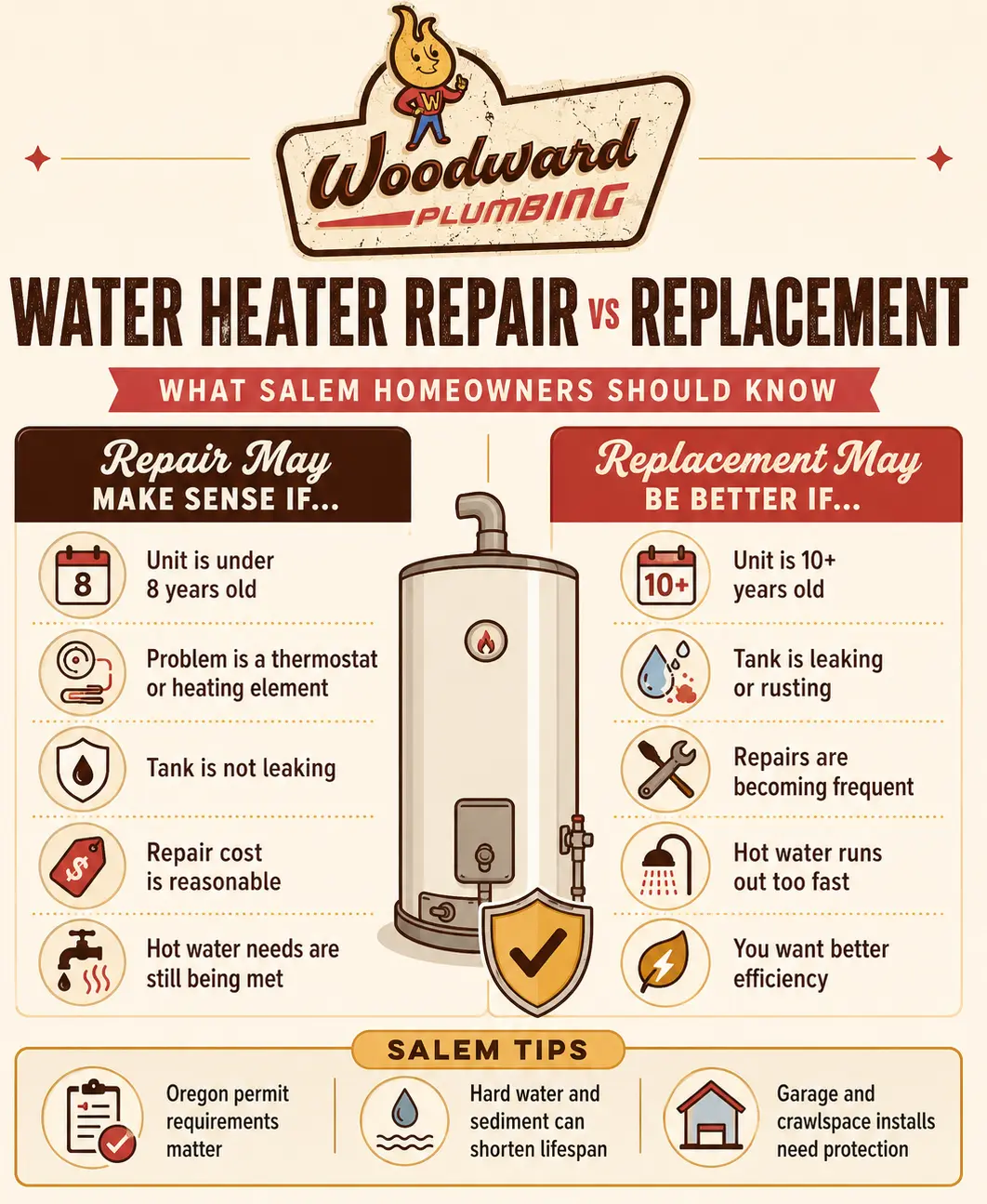
You should usually repair your water heater if it is less than 8 years old, the tank is not leaking, the problem is limited to a thermostat, heating element, gas control valve, pilot assembly, pressure relief valve, or minor plumbing connection, and the repair cost is reasonable compared to the cost of a new unit.
You should usually replace your water heater if it is 10 to 12 years old or older, the tank is leaking, hot water runs out faster than it used to, the water is rusty, the unit makes loud popping or rumbling sounds, repairs are becoming frequent, or your household has outgrown the system.
A helpful rule is this: if the repair is minor and the tank is in good condition, repair may be worthwhile. If the repair is expensive and the unit is already near the end of its expected life, replacement is usually the more practical long-term choice.
How Long Do Water Heaters Usually Last?
Most traditional tank water heaters last about 8 to 12 years, depending on installation quality, water quality, maintenance, usage, and whether the unit is gas or electric. Some well-maintained units last longer, while neglected units may fail earlier.
According to the International Association of Certified Home Inspectors, the typical water heater has a lifespan of about 10 years, but that lifespan can vary based on installation, usage, construction quality, and maintenance. water heater lifespan guide
Tankless water heaters often last longer than traditional tank units when they are properly maintained. However, they still need periodic flushing or descaling, especially in areas with mineral-heavy water. Homeowners considering a switch can learn more about tankless water heaters in Salem and whether that setup makes sense for their home.
Age alone does not automatically mean replacement is required, but it matters. A 4-year-old water heater with a failed thermostat is usually a repair candidate. A 13-year-old tank with sediment noise, rusty hot water, and a small leak near the base is usually not.
Common Water Heater Problems That Can Usually Be Repaired
Not every water heater problem means the whole system is failing. Many issues come from replaceable parts or maintenance-related problems. A professional inspection can identify whether the tank itself is still sound.
No Hot Water
If an electric water heater is producing no hot water, the cause may be a tripped breaker, failed heating element, bad thermostat, wiring issue, or reset button problem. These are often repairable if the tank is not leaking and the unit is not too old.
For a gas water heater, no hot water may point to a pilot light problem, thermocouple issue, gas control valve failure, burner problem, or venting issue. Gas water heater repair should be handled carefully because improper diagnosis can create safety concerns.
Not Enough Hot Water
If your water heater still works but runs out of hot water too quickly, the issue may be a failing lower heating element, sediment buildup, a broken dip tube, incorrect thermostat setting, or a tank that is too small for your household.
This is one of the most common homeowner complaints. People often describe it as “the shower starts hot but turns cold halfway through,” or “we used to get two showers, now we barely get one.” That symptom does not always mean the water heater needs replacement, but it does mean the system should be checked.
Water Is Too Hot or Not Hot Enough
Temperature issues can come from thermostat settings, thermostat failure, heating element failure, or gas valve problems. If the heater is newer, this is often repairable. If the heater is older and temperature problems are happening along with noise, rust, or leaks, replacement may be the better option.
Pilot Light Keeps Going Out
On a gas water heater, a pilot light that keeps going out may be caused by a bad thermocouple, dirty pilot assembly, gas supply issue, draft problem, or gas control valve issue. Some of these are straightforward repairs. Others may indicate a larger safety or combustion issue.
Leaking From a Valve or Pipe Connection
Leaks from supply connections, shutoff valves, drain valves, or the temperature and pressure relief valve may be repairable. The key question is where the water is coming from. A leak from a replaceable fitting is very different from a leak coming from the tank itself.
Minor Sediment Noise
Light popping, crackling, or rumbling may come from sediment buildup inside the tank. If caught early, flushing the tank may help. However, if sediment has hardened at the bottom of the tank or the unit is already old, flushing may not solve the issue completely.
Water Heater Problems That Usually Mean Replacement
Some symptoms point to deeper failure. When the tank itself is compromised, repairs are usually not practical because the storage tank is not a replaceable part.
The Tank Is Leaking
A leaking tank almost always means replacement. If water is coming from the bottom of the water heater or from the tank body itself, the internal lining may have failed and the steel tank may be corroding. Once that happens, the leak will usually get worse.
Homeowners sometimes ask whether a leaking water heater can be patched. In most cases, no. A leaking tank is under pressure and exposed to heat, expansion, contraction, and corrosion. Patching is not a reliable or safe long-term repair.
Rusty Hot Water
Rusty water that appears only when using hot water can be a warning sign that the inside of the water heater tank is corroding. If both hot and cold water are rusty, the issue may be elsewhere in the plumbing system. If only hot water is affected, the water heater should be inspected.
Repeated Repairs
If you have already repaired your water heater once or twice and another issue appears, replacement may be more cost-effective. Repeated repairs often mean the unit is aging as a system, not just experiencing one isolated part failure.
Loud Rumbling or Banging
Heavy sediment buildup can create loud rumbling or banging sounds as water heats beneath hardened mineral deposits. This makes the water heater work harder, reduces efficiency, and can overheat the tank bottom. If the heater is older and noisy, replacement is often the better long-term decision.
The Unit Is More Than 10 to 12 Years Old
An older water heater is not automatically bad, but age changes the math. A minor repair may still be worthwhile, but a costly repair on a 12-year-old tank may only delay replacement for a short time. If the unit is already past its expected service life, replacing it can prevent the inconvenience of sudden failure.
Repair vs Replacement: Key Factors to Compare
1. Age of the Water Heater
Age is one of the first things to check. If your water heater is newer than 8 years old and the tank is not leaking, repair is often reasonable. If it is 10 years old or older, replacement becomes more likely, especially if the repair is expensive.
2. Type of Problem
Replaceable parts make repair more appealing. Tank failure makes replacement necessary. A thermostat, heating element, pilot assembly, gas control valve, expansion tank, shutoff valve, or pressure relief valve can often be repaired. A corroded tank usually cannot.
3. Cost of Repair
If the repair is inexpensive and the water heater is otherwise in good condition, repair may be the better option. If the repair cost is a large percentage of replacement cost, replacement may be smarter. InterNACHI notes that if annual repair cost is greater than 10% of the cost of buying and installing a new water heater, repairing damaged parts may not be worthwhile. water heater lifespan guide
4. Energy Efficiency
Older water heaters often use more energy than newer models. Energy.gov notes that water heating accounts for about 18% of a home’s energy use and is typically the second-largest energy expense in a home. water-heating energy-saving tips
If your current unit is inefficient, poorly insulated, or constantly reheating water, a new unit may reduce operating costs over time. The savings may not cover the entire replacement cost immediately, but they can improve the long-term value of the upgrade.
5. Household Hot Water Demand
A water heater that was correctly sized years ago may no longer fit the home. If your household has grown, you added a bathroom, installed a large tub, remodeled the kitchen, or changed laundry habits, your existing unit may be undersized.
Repairing an undersized water heater will not solve the core issue. In that case, replacement with the right capacity may provide better comfort and performance.
6. Safety and Code Requirements
Replacement may also be a chance to correct older installation issues. In Oregon, water heater replacement requires proper permitting because water heaters are considered pressure vessels. The Oregon Building Codes Division explains that replacing water heaters requires a permit and that licensed plumbing contractors may use a minor label permit for replacement work. Oregon water heater permit requirements
Code-related items may include venting, combustion air, seismic strapping, drain pans, temperature and pressure relief discharge piping, expansion control, electrical connections, gas connections, and proper clearances.
Water Heater Replacement in Salem: What Makes Local Homes Different?
Water heater decisions in Salem are shaped by local housing patterns, climate, and plumbing conditions. Many Salem-area homes have older plumbing layouts, garage installations, utility closets, crawlspaces, and remodels that were completed over several decades. Those details can affect both repair access and replacement complexity.
Older Homes and Mixed Plumbing Materials
Older Salem homes may have copper, galvanized steel, PEX, CPVC, or a combination of materials depending on when the home was built or remodeled. When replacing a water heater, surrounding shutoff valves, flex connectors, venting, and pipe transitions should be inspected too.
If the water heater is old, the nearby plumbing components may also be aging. A replacement project may reveal corroded shutoff valves, outdated connectors, improper venting, or missing safety features that should be corrected at the same time.
Oregon Moisture and Garage Installations
Many water heaters are installed in garages, basements, laundry rooms, or utility closets. Oregon’s damp climate can contribute to exterior corrosion, especially if the unit sits directly on concrete or near areas with poor drainage. A drain pan, proper elevation, and leak detection can help reduce damage risk.
Cold Weather and Pipe Protection
Salem does not experience extreme winter conditions as often as colder regions, but freezing temperatures do happen. Water heater piping in garages, crawlspaces, and exterior walls should be insulated to reduce freeze risk and heat loss.
Regional Water Conditions
Water quality can affect water heater lifespan. Mineral buildup can collect at the bottom of a tank, causing noise, reduced efficiency, and damage to heating elements. If your home has recurring sediment problems, water heater maintenance should be part of your regular plumbing routine.
Should You Switch to a Tankless Water Heater?
Tankless water heaters can be a good option for some Salem homeowners, but they are not the right fit for every home. A tankless system heats water on demand instead of storing hot water in a tank. That can reduce standby energy loss and free up space.
Tankless water heaters may be worth considering if you want longer equipment life, improved efficiency, more usable space, or better hot water performance for certain household patterns. They may also be helpful in homes where the existing tank location is cramped or difficult to access.
However, tankless systems can require gas line upgrades, venting changes, electrical work, water treatment, and regular descaling. For homes with high simultaneous hot water demand, sizing is especially important. One undersized tankless unit may struggle if multiple showers, laundry, and a dishwasher run at the same time.
For homeowners comparing options, the choice is not simply “tankless is better” or “tank is better.” The right choice depends on the home’s plumbing layout, fuel source, household size, usage patterns, budget, and long-term plans.
Tank vs Tankless Water Heater Comparison
| Factor | Traditional Tank Water Heater | Tankless Water Heater |
|---|---|---|
| Upfront Cost | Usually lower | Usually higher |
| Lifespan | Often 8 to 12 years | Often longer with proper maintenance |
| Hot Water Supply | Limited by tank size | Continuous when properly sized |
| Energy Use | Uses energy to keep stored water hot | Heats water only when needed |
| Maintenance | Flushing and anode rod checks | Flushing/descaling and filter cleaning |
| Best Fit | Homes wanting lower upfront cost and simple replacement | Homes wanting efficiency, space savings, and long-term performance |
How Water Heater Maintenance Affects Repair vs Replacement
Maintenance can extend the life of a water heater and reduce the chance of unexpected failure. It can also make repair more worthwhile because a well-maintained unit is less likely to have hidden tank damage.
Flush the Tank
Flushing helps remove sediment from the bottom of the tank. Sediment forces the heater to work harder and can cause popping or rumbling sounds. In homes with mineral-heavy water, flushing may be needed more often.
Check the Anode Rod
The anode rod helps protect the steel tank from corrosion. Once the rod is depleted, the tank itself becomes more vulnerable. Replacing the anode rod can extend the life of a water heater, especially if the unit is not already too old.
Inspect the Pressure Relief Valve
The temperature and pressure relief valve is a critical safety component. If pressure or temperature inside the tank becomes too high, the valve helps release it. A faulty valve should be replaced.
Look for Moisture Around the Base
Check around the base of the water heater periodically. Small leaks can start slowly before becoming major problems. A drain pan and water alarm can help catch leaks early.
Insulate Exposed Pipes
Insulating hot water pipes can reduce heat loss and help protect plumbing during cold weather. This is especially useful in garages, crawlspaces, and other cooler areas common in Oregon homes.
What Homeowners Often Get Wrong About Water Heater Repair
Homeowner forums and plumbing discussions reveal several recurring misconceptions about water heaters. These concerns are understandable, but they can lead to poor decisions if not clarified.
“If It Still Works, I Should Ignore It”
If the water heater is newer and working well, ignoring it may be fine. But if the unit is older than 10 years, it is smart to inspect it, check the installation date, look for signs of corrosion, and plan ahead. Waiting until failure can lead to water damage or rushed replacement decisions.
“A Leak Can Be Patched”
Leaks from valves or fittings may be repairable. Leaks from the tank are different. A corroded tank cannot be reliably patched because the internal failure will continue spreading.
“Flushing Always Fixes Noise”
Flushing may help if sediment is loose. If sediment has hardened over years, flushing may not remove it. On very old tanks, flushing can sometimes expose leaks that were hidden by buildup.
“Tankless Always Saves Money Immediately”
Tankless water heaters can improve efficiency, but savings depend on usage, fuel type, installation cost, maintenance, and whether upgrades are needed. The best choice should be based on the home, not a blanket assumption.
“The Cheapest Replacement Is the Best Option”
A low-cost unit may solve the immediate problem, but sizing, warranty, energy efficiency, installation quality, and code compliance all matter. Poor installation can shorten the life of even a good water heater.
When Water Heater Repair Makes the Most Sense
Water heater repair is usually the best choice when the unit is still within its expected lifespan, the problem is isolated, the tank is not leaking, and the repair cost is reasonable.
Repair may make sense if:
- The water heater is less than 8 years old.
- The issue is a thermostat, heating element, thermocouple, pilot assembly, or valve.
- The tank is not leaking.
- The water is not rusty.
- The unit has been maintained.
- The repair cost is low compared to replacement.
- The heater still meets your household’s hot water demand.
For example, a 6-year-old electric water heater with one failed heating element is usually a good repair candidate. A 5-year-old gas water heater with a faulty thermocouple may also be worth repairing. In those cases, replacing the whole unit may be unnecessary.
If you are comparing repair options in nearby areas, Woodward Plumbing also supports homeowners needing water heater repair experts in McMinnville, Corvallis, and Keizer.
When Water Heater Replacement Makes the Most Sense
Water heater replacement is usually the better choice when the unit is older, inefficient, leaking, undersized, or starting to need repeated repairs. Replacement may cost more upfront, but it can reduce future repair costs, improve performance, and lower energy use.
Replacement may make sense if:
- The water heater is 10 to 12 years old or older.
- The tank is leaking.
- Hot water runs out much faster than it used to.
- You see rusty hot water.
- The unit makes loud rumbling, popping, or banging sounds.
- Repairs are becoming more frequent.
- The current unit is too small for your household.
- You want a more efficient model.
- The existing installation is outdated or not code-compliant.
Replacement also gives you the opportunity to choose the right fuel type, capacity, recovery rate, venting setup, and efficiency rating for your current home. If your family has grown or your remodel added more fixtures, replacement may solve comfort issues that repair cannot.
How to Decide: A Simple Homeowner Checklist
Use this checklist to decide whether repair or replacement is more likely:
Step 1: Find the Age of the Unit
Look for the manufacturer label on the side of the tank. The serial number often includes the manufacture date. If the unit is newer, repair may be more practical. If it is older than 10 years, replacement should be considered.
Step 2: Identify the Source of the Problem
A plumber can determine whether the issue is coming from the tank, burner, heating element, thermostat, valve, plumbing connection, venting, or electrical supply. The source of the problem matters more than the symptom alone.
Step 3: Compare Repair Cost to Replacement Cost
If the repair is inexpensive and the water heater has useful life remaining, repair may be the better choice. If the repair is expensive and the unit is already near the end of its lifespan, replacement is usually more practical.
Step 4: Consider Efficiency
Older units may still heat water, but they can use more energy to do it. If energy bills are rising or the unit struggles to recover after normal use, a newer system may be worth considering.
Step 5: Think About Future Use
If you plan to stay in the home, replacement may offer better long-term value. If you are planning a remodel, adding bathrooms, or changing household usage, sizing the new system correctly can prevent future hot water issues.
Water Heater Replacement Costs: What Affects the Price?
Water heater replacement costs vary because every home is different. The final cost can depend on the type of heater, size, fuel source, access, code updates, venting requirements, permit requirements, and whether any surrounding plumbing needs repair.
Common cost factors include:
- Tank vs tankless system
- Gas vs electric water heater
- Standard efficiency vs high-efficiency model
- Tank size and recovery rate
- Location and accessibility
- Permit and inspection requirements
- Venting updates
- Drain pan and safety upgrades
- Expansion tank or pressure control needs
- Removal and disposal of the old unit
A basic like-for-like tank replacement is usually simpler than converting to tankless or switching fuel types. However, even a standard replacement should be installed safely, permitted properly, and sized correctly.
Can Energy Efficiency Help Justify Replacement?
Energy efficiency is one of the main reasons homeowners replace a working but aging water heater. Newer models often have better insulation, improved burners, smarter controls, or heat pump technology.
Energy.gov recommends reducing water heating costs by using less hot water, turning down the thermostat, insulating the water heater and pipes, and buying a more efficient model when replacement is needed. water-heating energy-saving tips
High-efficiency systems may also qualify for rebates or tax credits. Before purchasing, Salem homeowners should check current federal incentives, local utility programs, and manufacturer eligibility. Incentives change over time, so it is worth confirming details before installation.
What to Expect During a Water Heater Replacement
A professional water heater replacement usually includes removing the old unit, preparing the installation area, setting the new unit, connecting water lines, connecting gas or electrical service, verifying venting, installing required safety components, filling the tank, checking for leaks, testing operation, and reviewing the system with the homeowner.
In Oregon, replacement may also include permitting and inspection requirements. That is one reason working with a licensed plumber can make the process smoother. The installer should know how to handle local code requirements, safety clearances, seismic strapping, pressure relief discharge piping, and any required updates.
If you are replacing a tank with another tank, the process may be relatively straightforward. If you are switching to tankless, moving the heater, changing fuel type, or upgrading electrical capacity, the project may involve more planning.
How to Prevent Early Water Heater Failure
Whether your water heater is new or older, consistent maintenance can reduce the chance of early failure. A few simple habits can make a major difference.
- Flush the tank regularly: This helps remove sediment and improve efficiency.
- Inspect the anode rod: Replacing it before it is fully depleted can slow tank corrosion.
- Watch for leaks: Check the base, fittings, valves, and drain pan periodically.
- Keep the area clear: Avoid storing items too close to the water heater, especially gas units.
- Insulate exposed hot water pipes: This helps reduce heat loss and protects pipes in colder areas.
- Install a leak alarm: A water sensor can alert you before a small leak becomes major damage.
- Schedule service when performance changes: Do not ignore popping sounds, rusty water, or inconsistent temperatures.
For homeowners planning ahead, routine maintenance may delay replacement and make repairs more worthwhile. For older units, maintenance can still help, but it should be paired with replacement planning so you are not surprised by a sudden failure.
FAQ: Water Heater Repair vs Replacement in Salem
How do I know if I need water heater repair or replacement?
You may only need repair if your water heater is relatively new, the tank is not leaking, and the issue is caused by a replaceable part such as a thermostat, heating element, pilot assembly, or valve. Replacement is more likely if the tank is leaking, the unit is over 10 years old, repairs are becoming frequent, or hot water performance has declined significantly.
What is the average lifespan of a water heater?
Most traditional tank water heaters last about 8 to 12 years. Some last longer with good maintenance, while others fail sooner due to poor installation, heavy use, sediment buildup, or corrosion. Tankless units often last longer but require regular maintenance.
Is it worth repairing a 10-year-old water heater?
It depends on the problem. A small, inexpensive repair may be worthwhile if the tank is not leaking and the unit has been well maintained. However, an expensive repair on a 10-year-old or older unit may not be the best investment, especially if other warning signs are present.
Can a leaking water heater be repaired?
If the leak is coming from a valve, fitting, or pipe connection, it may be repairable. If the leak is coming from the tank itself, the water heater usually needs to be replaced. A leaking tank cannot be reliably patched.
Why is my water heater making popping or rumbling sounds?
Popping or rumbling usually comes from sediment buildup at the bottom of the tank. Water trapped beneath hardened sediment turns to steam and creates noise. Flushing may help if the buildup is not severe, but older noisy units may need replacement.
Why does my hot water run out so fast?
Fast hot water loss can be caused by sediment buildup, a failed heating element, a broken dip tube, thermostat problems, or an undersized tank. If the unit is newer, repair may solve the issue. If it is older or too small for the home, replacement may be better.
Do I need a permit for water heater replacement in Oregon?
Yes. Oregon requires permits for water heater replacement because water heaters are pressure vessels. A licensed plumbing contractor may be able to obtain a minor label permit, but the installation still needs to meet safety and code requirements.
Should I switch from a tank water heater to tankless?
Tankless may be a good option if you want improved efficiency, space savings, and continuous hot water. However, it may require gas line upgrades, venting changes, electrical work, or water treatment. The best choice depends on your household demand, budget, fuel source, and installation conditions.
How often should I flush my water heater?
Most homeowners should flush a tank water heater about once per year. Homes with more sediment or mineral buildup may need more frequent maintenance. Tankless units also need periodic descaling based on water quality and manufacturer recommendations.
What temperature should my water heater be set to?
Many households use a setting around 120°F to balance comfort, energy efficiency, and scald prevention. If your household has special needs, young children, elderly residents, or specific appliance requirements, ask a plumber about the safest setting.
Can water heater maintenance prevent replacement?
Maintenance can extend the life of a water heater, but it cannot prevent replacement forever. Flushing, anode rod replacement, valve checks, and leak monitoring can reduce wear and improve performance, but all water heaters eventually reach the end of their service life.
What are the signs of a failing gas water heater?
Common signs include pilot light problems, burner issues, delayed ignition, soot, rumbling sounds, inconsistent hot water, gas odors, or water around the tank. Gas-related concerns should be checked by a professional because safety and venting are involved.
What are the signs of a failing electric water heater?
Common signs include no hot water, lukewarm water, tripped breakers, failed heating elements, thermostat problems, rust-colored hot water, noise, or leaks around the tank. Some electrical components can be repaired, but tank leaks usually require replacement.
Should I replace my water heater before it fails?
Proactive replacement can make sense if the unit is old, located in an area where a leak could cause major damage, or showing early warning signs. Waiting until complete failure can lead to emergency costs, water damage, and rushed equipment decisions.
What size water heater do I need?
The right size depends on household size, fixture count, bathing habits, laundry use, dishwasher use, and whether multiple hot water fixtures run at the same time. A plumber can help size the system based on first-hour rating, recovery rate, and actual household demand.
Final Thoughts: Repair When It Makes Sense, Replace When It Protects the Home
Water heater repair vs replacement is not always an obvious decision. A newer unit with a single failed part may be worth repairing. An older unit with leaks, rust, sediment noise, or repeated issues is usually a better candidate for replacement.
For Salem homeowners, the decision should also account for Oregon code requirements, local water conditions, damp installation areas, older plumbing materials, and household hot water needs. A careful inspection can help determine whether the problem is minor or whether the tank is nearing the end of its life.
If you are comparing options, Woodward Plumbing can help evaluate the condition of your current unit, explain repair possibilities, and recommend the right replacement when needed. Whether you are considering a traditional tank, a high-efficiency model, or tankless water heaters, the goal is the same: reliable hot water, safe installation, and a system that fits your home.