

Clean, dependable water supports nearly every part of daily life, from drinking and cooking to bathing, laundry, cleaning, and protecting plumbing fixtures. Although public water systems treat water before it reaches local homes, some homeowners still notice concerns such as unpleasant tastes, chlorine odors, mineral residue, cloudy water, staining, sediment, or uncertainty about what may be present in their water supply.
Private well owners may face a different set of questions involving bacteria, nitrates, arsenic, iron, sediment, or changing groundwater conditions. Because municipal water and well water can have very different characteristics, choosing among the many available water treatment systems for home use should begin with understanding the source of the water and the specific problem that needs to be addressed.
There is no single treatment system that solves every water quality concern. Water filters, water softeners, reverse osmosis systems, ultraviolet purifiers, and other technologies all perform different functions. The right solution may treat water throughout the entire plumbing system, or it may focus only on the water used for drinking and cooking.
This guide explains how common home water treatment systems work, what they are designed to address, and how Oregon homeowners can make informed decisions about improving their water quality.
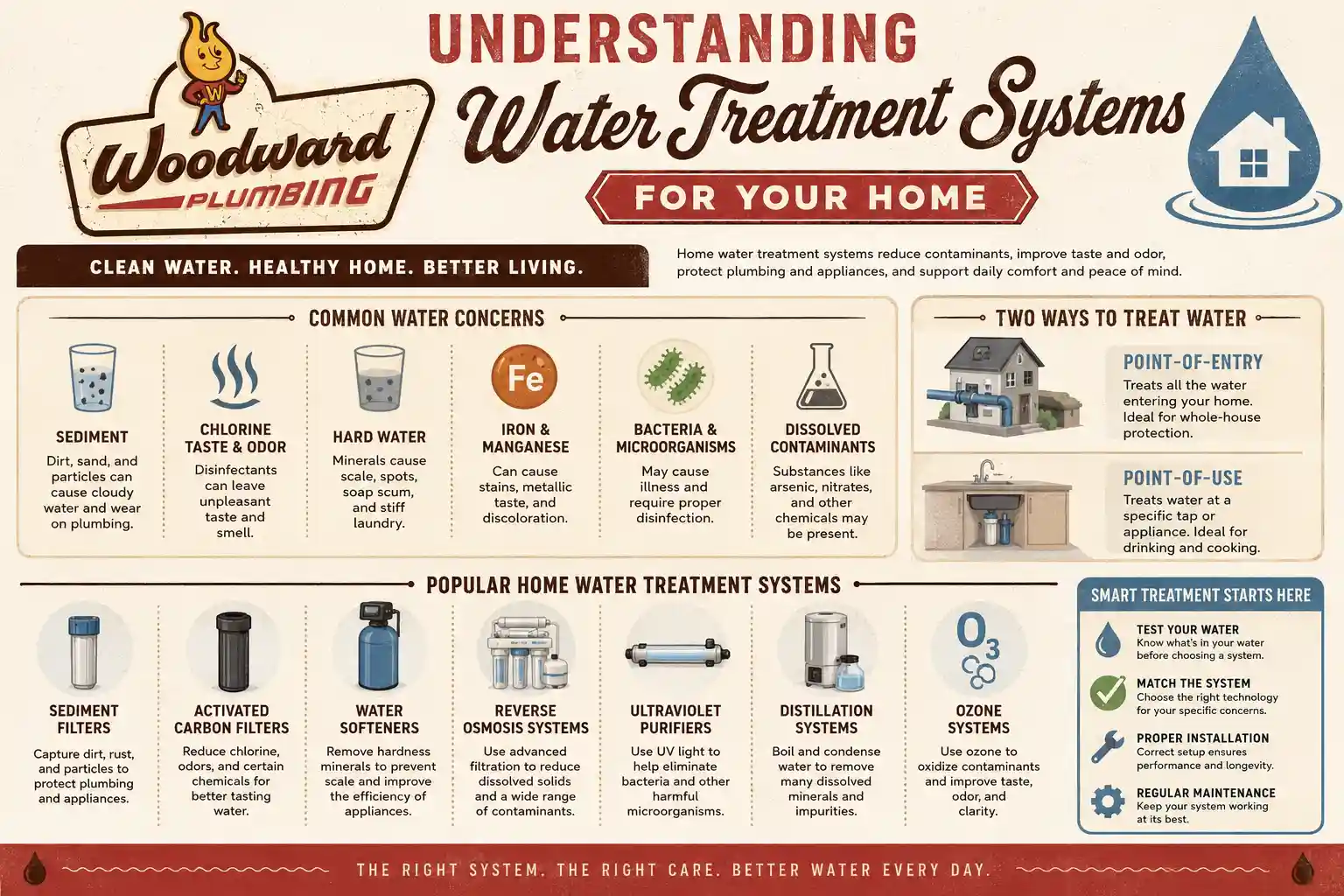
What Are Home Water Treatment Systems?
Home water treatment systems are devices or combinations of equipment designed to change certain characteristics of the water entering or being used inside a home. Depending on the technology, a system may reduce sediment, improve taste and odor, remove hard minerals, address microorganisms, or reduce specific contaminants.
Some systems treat all the water entering the building. Others treat water only at a particular sink, refrigerator, or drinking water faucet. This distinction is important because a household that wants better-tasting drinking water may need a very different solution from a household dealing with scale buildup throughout its plumbing system.
Common categories of residential water treatment include:
- Whole-house water filters
- Point-of-use drinking water filters
- Reverse osmosis systems
- Water softeners and conditioners
- Ultraviolet purification systems
- Sediment filters
- Activated carbon filters
- Distillation systems
- Specialized systems for iron, sulfur, arsenic, nitrates, or other concerns
The most effective system is one selected for a clearly identified water problem. Homeowners who are unsure where to begin can learn more about professional water treatment services in Salem, OR, including testing, system selection, installation, and ongoing maintenance.
Why Water Quality Can Vary Between Homes
Two homes in the same general area can experience different water quality concerns. Water source, neighborhood infrastructure, household plumbing materials, private well depth, soil conditions, seasonal changes, and the age of the plumbing system can all affect what a homeowner notices at the tap.
Municipal Water
Municipal water is treated and monitored before it enters the public distribution system. Salem receives its drinking water from the North Santiam Watershed, and the city conducts ongoing testing and publishes information about water quality for local residents.
Homeowners connected to municipal water may still choose additional treatment to address personal preferences or household-specific concerns. Common reasons include reducing chlorine taste or odor, improving water used for coffee and cooking, filtering fine sediment, or adding another level of treatment at a kitchen sink.
Residents who want to understand what has been detected in the local supply can review the City of Salem annual water quality report. A water quality report provides helpful background, but it may not identify problems introduced by a home’s internal pipes, fixtures, or water heater.
Private Well Water
Private wells are not managed in the same way as municipal systems. The property owner is generally responsible for testing the well and selecting treatment equipment when needed. Groundwater conditions can vary from one property to another, even between nearby homes.
Well water may contain naturally occurring minerals, sediment, iron, manganese, arsenic, nitrates, sulfur compounds, or microorganisms. Some of these concerns may affect taste, odor, color, or plumbing performance, while others can require contaminant-specific treatment.
The Oregon Health Authority provides Oregon well testing recommendations for bacteria, nitrates, arsenic, and other concerns. Testing is especially important after flooding, well repairs, changes in taste or odor, nearby land-use changes, or long periods without testing.
Common Water Quality Problems in Oregon Homes
Water does not need to appear visibly dirty for a homeowner to have a legitimate water quality concern. Many issues are first noticed through taste, odor, staining, residue, or changes in how appliances and fixtures perform.
Chlorine Taste or Odor
Disinfectants are used by public water systems to control microorganisms during treatment and distribution. Some people are more sensitive to the resulting taste or smell, especially in drinking water, ice, coffee, and tea.
Activated carbon filters are commonly used to reduce chlorine-related tastes and odors. Depending on the household’s goals, carbon treatment may be installed at one faucet or as part of a whole-house water filtration system.
Cloudy Water or Sediment
Cloudiness can sometimes be caused by harmless air bubbles, but persistent particles or grit may indicate sediment. Sediment can originate from a private well, water main work, aging pipes, corrosion, or debris entering the plumbing system.
A sediment filter captures suspended particles before they reach faucets and appliances. The correct filter size and micron rating depend on the type and quantity of material present.
Hard Water and Mineral Buildup
Hard water contains dissolved calcium and magnesium. These minerals are not automatically a drinking water safety problem, but they can create scale on faucets, shower doors, dishes, plumbing fixtures, heating elements, and appliance components.
Other common signs of hard water include:
- White or chalky residue around faucets
- Cloudy spots on glassware
- Soap that does not lather easily
- Stiff-feeling laundry
- Mineral deposits inside kettles or coffee makers
- Scale accumulation in water heaters
Water softeners are designed specifically to address hardness minerals. They do not serve the same purpose as a standard carbon water filter. Homeowners comparing these technologies can review Woodward Plumbing’s guide to choosing a water softener vs. a whole-house filter.
Metallic Taste, Staining, or Discoloration
Iron and manganese can cause metallic flavors, reddish-brown staining, dark residue, or discoloration in sinks, tubs, and laundry. These concerns are more common in some private well systems but can also be associated with corrosion or older plumbing materials.
Treatment depends on the form and concentration of the metal. A basic cartridge filter may not be enough. Some homes require oxidation, specialized filter media, pH adjustment, or a combination of treatment stages.
Unpleasant or Sulfur-Like Odors
A rotten-egg odor is often associated with hydrogen sulfide, certain bacteria, or reactions inside a water heater. The smell may be present in both hot and cold water, or only on the hot-water side.
Identifying where and when the odor occurs helps determine the source. Treating the entire water supply is not always necessary when the problem originates inside the water heater or a specific section of plumbing.
Microorganisms
Bacteria, viruses, and parasites require a different treatment approach from hardness minerals or chlorine taste. Private wells may need disinfection after testing identifies microbial contamination or following events that could allow surface water to enter the well.
Ultraviolet treatment, chlorination, boiling, and certain membrane technologies can address microorganisms under the right conditions. Pretreatment is often necessary because sediment or cloudy water can interfere with disinfection performance.
Point-of-Use Systems vs. Point-of-Entry Systems
One of the first decisions when comparing water treatment systems for home use is whether to treat water at a single location or throughout the property.
Point-of-Use Systems
Point-of-use systems treat water at the location where it will be consumed or used. These systems may be installed under a kitchen sink, connected to a faucet, placed inside a refrigerator, or built into a countertop appliance.
Common point-of-use systems include:
- Under-sink carbon filters
- Reverse osmosis drinking water systems
- Faucet-mounted filters
- Refrigerator filters
- Filtered water pitchers
- Countertop distillers
A point-of-use system may be appropriate when the main goal is improving drinking and cooking water. It can provide targeted treatment without filtering every gallon used for showers, toilets, landscaping, and laundry.
Point-of-Entry Systems
Point-of-entry systems are installed near the main water line and treat water before it is distributed throughout the home. They are commonly called whole-house systems.
Examples include:
- Whole-house sediment filters
- Whole-house activated carbon filters
- Water softeners
- Iron and manganese filters
- Ultraviolet disinfection systems
- Combined filtration and conditioning systems
Whole-house treatment is generally considered when the concern affects fixtures, plumbing, appliances, bathing water, laundry, or multiple faucets. Woodward Plumbing provides information about professionally installed water filtration systems in Salem for homeowners considering treatment at the main water line.
Types of Water Treatment Systems for Home Use
Activated Carbon Filters
Activated carbon is one of the most common materials used in residential water filters. Its porous surface attracts and holds certain compounds as water passes through the filter media.
Activated carbon filters are commonly used to improve:
- Chlorine taste and odor
- Some organic compounds
- General drinking water taste
- Odors associated with certain chemicals
Carbon filters do not remove every contaminant. Performance varies according to the filter design, amount of carbon, flow rate, contact time, and certification claims. A filter should be selected based on the substances it has been tested to reduce, not simply because the packaging uses the words “clean” or “pure.”
Sediment Filters
Sediment filters capture physical particles such as sand, rust, dirt, silt, and pipe debris. They are often used as a first stage before carbon filtration, reverse osmosis, UV treatment, or specialized well-water equipment.
Filters are rated by micron size. A lower micron rating captures smaller particles but may also restrict flow or require more frequent replacement. The ideal rating depends on the water test, visible sediment, household flow requirements, and the equipment being protected downstream.
Whole-House Water Filters
Whole-house water filters treat water before it reaches individual fixtures. Depending on the system, they may use sediment cartridges, activated carbon, catalytic carbon, specialized mineral media, or several treatment stages.
These systems can be useful when taste, odor, sediment, or another identified concern is present throughout the home. They may also help protect downstream equipment from particles and certain water quality conditions.
Whole-house filters should not automatically be confused with water softeners. Filtration generally captures or reduces targeted materials, while softening focuses primarily on calcium and magnesium. Homeowners looking for a broader Oregon-specific comparison can read about selecting the best water filtration system for Oregon homes.
Reverse Osmosis Systems
Reverse osmosis uses pressure to move water through a semipermeable membrane. The membrane separates treated water from a concentrated waste stream containing substances rejected by the system.
Residential reverse osmosis systems are commonly installed under a kitchen sink and may include:
- A sediment prefilter
- An activated carbon prefilter
- The reverse osmosis membrane
- A storage tank
- A carbon polishing filter
- A dedicated drinking water faucet
Depending on the system and its certified performance claims, reverse osmosis may reduce dissolved solids, certain metals, nitrates, fluoride, and other substances. It can also improve the taste of water used for drinking, ice, coffee, tea, and cooking.
Reverse osmosis is usually a point-of-use treatment rather than a whole-home solution. The process creates a reject-water stream and requires filter and membrane replacement. Professional sizing and installation help maintain proper pressure, drainage, storage capacity, and performance.
Homeowners interested in this type of targeted drinking water treatment can learn more about reverse osmosis systems in Salem, OR.
Water Softeners
Traditional water softeners use ion exchange to reduce calcium and magnesium. As hard water passes through a resin tank, hardness minerals are exchanged for sodium or potassium ions. The system periodically regenerates using a brine solution.
Water softeners can help reduce:
- Scale on fixtures and glass
- Mineral buildup in water heaters
- Soap scum
- Stiff laundry
- Hard-water deposits inside appliances
A softener is not designed to function as a universal contaminant filter. It does not replace carbon filtration, reverse osmosis, or microbial disinfection. Some homes benefit from combining a softener with sediment filtration, carbon filtration, or a point-of-use drinking water system.
Proper sizing depends on water hardness, household water usage, flow demand, number of occupants, plumbing size, and regeneration settings. More information is available on Woodward Plumbing’s page about water softener systems in Salem.
Ultraviolet Water Purifiers
Ultraviolet systems expose flowing water to UV light at a wavelength designed to inactivate microorganisms. UV treatment does not add chemicals to the water and can be useful for private wells with microbial concerns.
UV systems generally do not remove:
- Sediment
- Hardness minerals
- Arsenic
- Nitrates
- Iron
- Chlorine
- Dissolved chemicals
Clear water is essential for effective UV treatment. Sediment, iron, manganese, or cloudiness can shield microorganisms from the light. For this reason, UV equipment is often installed after filtration and other necessary pretreatment.
Distillation Systems
Distillation heats water to create steam and then condenses the steam into a separate container. Many dissolved substances remain behind during the process.
Residential distillers are generally used for relatively small quantities of drinking water. They require electricity, operate more slowly than most filters, and need regular cleaning to remove the concentrated residue left in the boiling chamber.
Some volatile compounds can travel with steam unless the system includes additional treatment. As with other technologies, homeowners should review the unit’s specific performance claims.
Ozone Water Purifiers
Ozone treatment introduces ozone gas into water to oxidize certain substances and support disinfection. It may be used in specialized systems for odor, iron, manganese, or microbial control.
Ozone equipment is more complex than a basic cartridge filter and is not the default choice for every household. Proper contact time, off-gas management, pretreatment, system design, and maintenance are important for safe and effective operation.
Combined Water Purification Systems
Some water quality problems require more than one treatment stage. A private well with sediment, iron, hardness, and bacteria may require a sediment filter, iron treatment, water softener, and UV purifier in a carefully arranged sequence.
A municipal-water household focused on taste and drinking water quality may use a whole-house carbon filter along with an under-sink reverse osmosis system. Combined systems should be designed so that one component protects and supports the next.
Woodward Plumbing offers additional information about water purification systems in Salem for homes requiring a customized treatment approach.
How to Choose the Right Water Treatment System
Choosing a system based only on advertising, appearance, or a neighbor’s recommendation can lead to unnecessary expense or disappointing performance. A treatment system should be matched to the water source, test results, household usage, plumbing configuration, and desired outcome.
1. Identify the Primary Concern
Start by writing down the exact problem being noticed. Useful details include:
- Does the water smell like chlorine, sulfur, metal, or earth?
- Is the problem present in hot water, cold water, or both?
- Is staining red, black, blue-green, orange, or white?
- Does residue appear on every fixture or only one?
- Is the concern limited to drinking water?
- Has the water changed recently?
- Does the home use municipal water or a private well?
These observations do not replace testing, but they can help narrow down the likely causes.
2. Test the Water
Water testing provides the clearest basis for treatment decisions. The type of test should reflect the water source and the concern being investigated.
A private well test may include bacteria, nitrates, arsenic, hardness, iron, manganese, pH, total dissolved solids, or other locally relevant substances. Municipal-water homeowners may start with the local water quality report and add household testing when they suspect issues related to internal plumbing, taste, odor, or a specific contaminant.
Testing is especially valuable before purchasing expensive whole-house equipment. It prevents homeowners from installing a water softener to solve an iron problem, buying a carbon filter for hardness, or selecting a UV system for a dissolved chemical concern.
3. Decide Where Treatment Is Needed
A kitchen-only concern may be handled efficiently with a point-of-use system. Problems affecting showers, laundry, appliances, and every faucet usually point toward point-of-entry treatment.
Some homes benefit from both. A whole-house filter may improve water throughout the plumbing system, while a reverse osmosis unit provides more advanced treatment at the kitchen sink.
4. Review Flow Rate and Household Demand
Whole-house equipment must support the home’s peak water demand. An undersized system can reduce pressure when showers, washing machines, dishwashers, or multiple faucets operate at the same time.
System sizing may depend on:
- Number of occupants
- Number of bathrooms
- Pipe diameter
- Well pump capacity
- Water pressure
- Peak flow rate
- Daily water usage
- Contaminant concentration
5. Consider Maintenance Requirements
Every treatment system requires some level of maintenance. Filter cartridges need replacement, softeners need salt or potassium, UV lamps require scheduled service, reverse osmosis membranes eventually wear out, and storage tanks may need sanitizing.
A system that is not maintained can lose effectiveness, restrict water flow, develop odors, or allow contaminants to pass through. Homeowners should understand the replacement schedule and ongoing cost before installation.
6. Look for Relevant Certifications
Product certification does not mean a filter removes every possible contaminant. It means the product has been evaluated according to a particular standard and performance claim.
Common standards include:
- NSF/ANSI 42: Commonly associated with aesthetic effects such as chlorine taste and odor
- NSF/ANSI 53: Covers specific contaminants with health-related effects
- NSF/ANSI 44: Applies to residential water softeners using ion exchange
- NSF/ANSI 55: Applies to ultraviolet microbiological water treatment systems
- NSF/ANSI 58: Applies to reverse osmosis drinking water systems
Homeowners can review NSF/ANSI water treatment standards to better understand certification labels and contaminant-reduction claims.
Why Professional Water Testing and Installation Matter
Store-bought test strips can provide a general indication of hardness, chlorine, pH, or other basic characteristics. More serious decisions involving private well safety or contaminant removal should rely on appropriate laboratory testing and professional interpretation.
Professional installation is also important for systems connected to the home’s plumbing. Incorrect installation can create low pressure, leaks, drainage problems, cross-connections, improper bypass arrangements, or reduced treatment performance.
A qualified plumber can evaluate:
- The location of the main water line
- Available space for tanks and filters
- Drain and electrical requirements
- Water pressure and flow rate
- Pipe size and material
- Well pump and pressure tank operation
- Bypass valve placement
- Outdoor faucets that may not require treatment
- Access for future filter changes and maintenance
Proper installation also makes future service easier. Filters, tanks, membranes, lamps, and control valves should remain accessible without requiring major plumbing modifications each time maintenance is performed.
Maintaining Home Water Treatment Systems
Even a high-quality system cannot provide reliable treatment indefinitely without maintenance. A maintenance schedule should be based on the manufacturer’s instructions, water usage, test results, water quality, and system performance.
Replace Filter Cartridges on Schedule
Cartridge filters collect sediment and other materials until they become restricted or exhausted. Delaying replacement can reduce pressure, allow breakthrough, or create unpleasant tastes and odors.
Some filters need replacement every few months, while larger media tanks may last several years. Actual service life depends on the amount of water used and the concentration of the material being removed.
Maintain Water Softener Salt Levels
Salt-based softeners require adequate brine to regenerate the resin. The brine tank should be checked regularly for low salt, salt bridges, sludge, or hardened material.
Using the correct salt and keeping the brine tank clean can support consistent performance. A sudden return of water spots or scale may indicate low salt, a clogged injector, incorrect settings, or exhausted resin.
Service UV Equipment
UV lamps lose intensity over time even when they continue to produce visible light. Lamps should generally be replaced according to the manufacturer’s schedule. The quartz sleeve surrounding the lamp also needs inspection and cleaning because mineral film can block UV exposure.
Sanitize Reverse Osmosis Systems
Reverse osmosis equipment requires periodic prefilter, postfilter, and membrane replacement. Storage tanks, filter housings, tubing, and faucets may also need sanitizing during service.
Changes in taste, reduced flow, slow tank refill, or continuous drain flow can indicate maintenance or repair needs.
Retest the Water
Treatment performance should be verified, particularly when a system was installed to address a health-related contaminant. Private well conditions can change, and treatment media can become exhausted.
Follow-up testing confirms that the equipment is still reducing the targeted substance and helps determine whether service intervals need adjustment.
Frequently Asked Questions About Water Treatment Systems for Home Use
Does every home need a water treatment system?
No. Many homes receive municipal water that meets applicable drinking water standards and may not require additional treatment. Some homeowners install filters to improve taste or odor, while private well owners may need treatment based on test results. The decision should be based on the water source, household preferences, and a clearly identified concern.
What is the difference between water filtration and water purification?
Water filtration is a broad term describing processes that reduce particles or specific substances as water passes through filter media or a membrane. Water purification is often used to describe more advanced treatment that may include reverse osmosis, ultraviolet disinfection, distillation, or multiple stages. Because marketing terminology varies, homeowners should focus on the system’s certified performance claims.
Is a water softener the same as a whole-house filter?
No. A water softener primarily reduces calcium and magnesium through ion exchange. A whole-house filter may reduce sediment, chlorine, odors, or other targeted substances. Some homes need only one of these systems, while others benefit from both.
Can a water filter remove hard water?
Most basic sediment and carbon filters do not remove dissolved hardness minerals. Traditional water softeners are designed for calcium and magnesium. Certain conditioning technologies may change how minerals behave, but they do not necessarily remove hardness from the water.
What does reverse osmosis remove?
Reverse osmosis may reduce dissolved solids and a range of specific contaminants, depending on the system design and certification. The membrane is commonly paired with sediment and carbon prefilters. Homeowners should verify that a system is certified for the particular substance they want to reduce.
Can UV treatment remove chemicals or hard minerals?
No. UV systems are designed to inactivate microorganisms. They do not remove sediment, calcium, magnesium, arsenic, nitrates, iron, chlorine, or dissolved chemicals. Additional filtration or treatment may be needed.
How often should private well water be tested?
Testing frequency depends on the contaminant, property conditions, and guidance from Oregon health authorities. Bacteria and nitrate testing may be recommended more frequently than testing for certain naturally occurring contaminants. Additional testing is appropriate after flooding, well repairs, changes in taste or odor, or nearby contamination concerns.
Can one system treat every water quality problem?
Usually not. Different technologies address different substances. A home with sediment, hardness, iron, and bacteria may require multiple treatment stages. Testing helps determine the correct treatment sequence.
Where should a whole-house water filter be installed?
Whole-house equipment is typically installed near the point where the main water line enters the home. Placement should allow room for bypass valves, filter changes, drainage, electrical connections, and future maintenance.
How long do home water treatment systems last?
Service life varies by equipment type. Disposable cartridges may last several months, while tanks, control valves, housings, and plumbing connections may last many years with proper maintenance. Reverse osmosis membranes, UV lamps, softener resin, and specialized filter media have different replacement schedules.
Should outdoor faucets receive treated water?
Not always. Softened or highly filtered water may not be necessary for irrigation, lawn care, or washing exterior surfaces. A professional installation can bypass selected outdoor lines to reduce treatment demand and operating costs.
What is the best water treatment system for a home?
The best system is the one properly matched to the home’s water source, test results, plumbing system, flow requirements, and treatment goals. A whole-house filter may be appropriate for widespread taste or sediment concerns, while reverse osmosis may be better for drinking water. Hardness generally requires a softener, and microbial concerns may require disinfection.
Finding the Right Water Treatment Solution for Your Home
Water treatment should begin with facts rather than assumptions. A filter that improves chlorine taste will not necessarily reduce hard minerals. A water softener will not disinfect a private well. A UV purifier will not remove arsenic, nitrates, or sediment. Each technology has a defined purpose, and some homes need a combination of systems to achieve the desired result.
Municipal-water homeowners can begin by reviewing the local water quality report and identifying household-specific concerns. Private well owners should establish a regular testing schedule and select treatment based on laboratory results. In both cases, proper sizing, installation, and maintenance are essential for dependable performance.
Woodward Plumbing can help homeowners evaluate water quality concerns, understand treatment options, and select equipment suited to their plumbing system and household demand. For help planning a new system or assessing an existing one, contact Woodward Plumbing to discuss professional water treatment services for your Oregon home.