A damaged sewer line does not automatically mean a contractor has to dig a continuous trench across your yard.
Many sewer problems can now be addressed with trenchless sewer repair, including cured-in-place pipe lining and pipe bursting. These methods can rehabilitate or replace qualifying underground sewer lines while reducing the amount of excavation required around landscaping, driveways, patios, walkways, and other improvements.
The important word is qualifying.
Trenchless technology cannot correct every sewer problem. The condition of the existing pipe, type of damage, alignment, grade, accessibility, nearby utilities, and location of the failure all help determine which repair method makes sense.
For Salem homeowners, the best place to start is not by asking, “Can you line my sewer?” It is by finding out what is actually wrong with the pipe.
How to Find Out if Your Sewer Can Be Repaired Without Digging
A good sewer repair decision usually follows a step-by-step process rather than choosing a repair method based only on the symptoms inside the home.
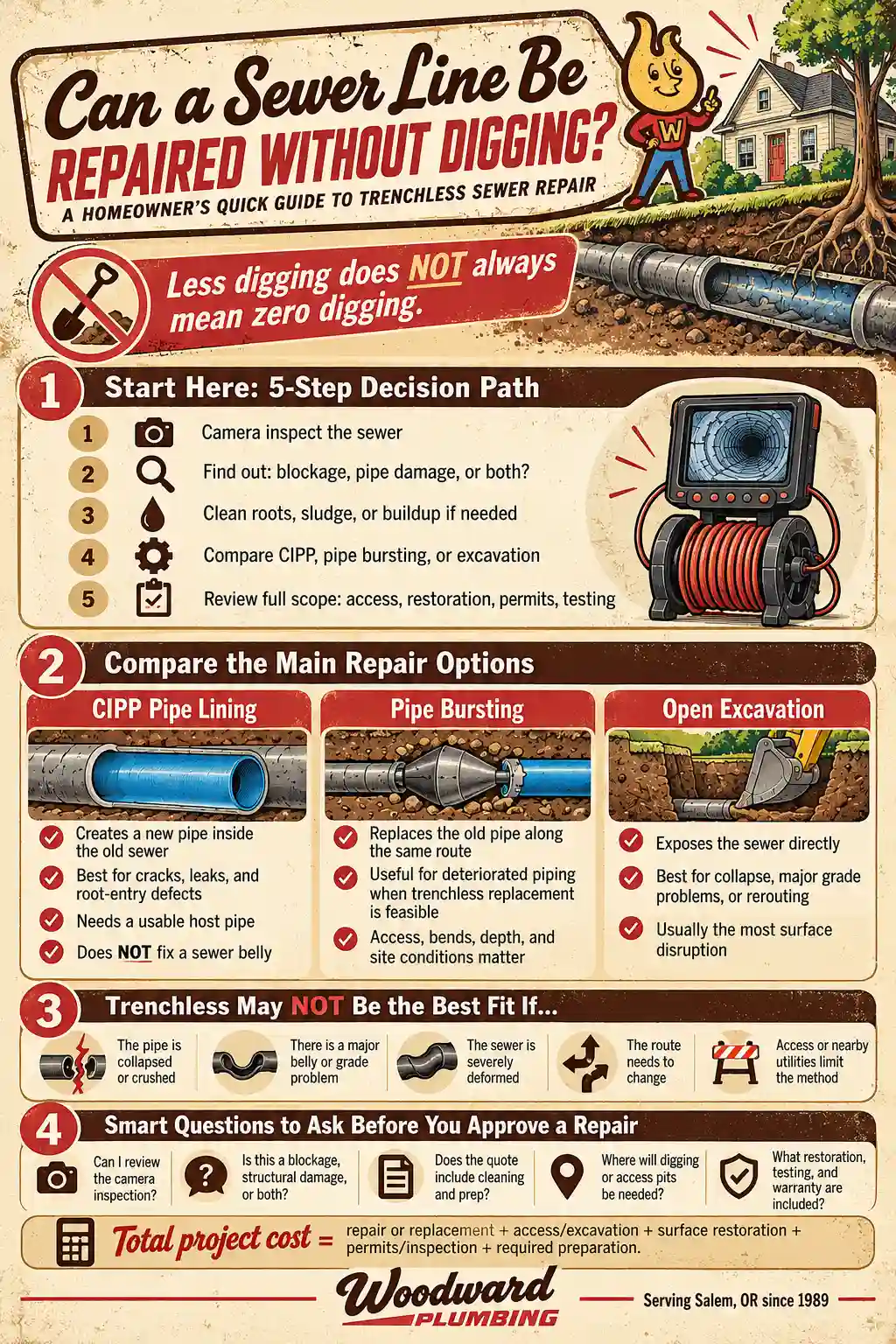
- Inspect and locate the problem. A sewer camera can help identify blockages, roots, damaged joints, cracks, standing water, deformation, and other visible conditions inside accessible portions of the line.
- Determine whether the problem is a blockage, structural damage, or both. A clogged sewer does not automatically require pipe repair.
- Clean the sewer when necessary. Roots, sludge, scale, grease, or other buildup may need to be removed before the condition of the pipe can be evaluated accurately.
- Evaluate the repair options. The findings may point toward CIPP lining, pipe bursting, localized excavation, conventional replacement, or sewer cleaning without structural repair.
- Compare the complete scope. Access, excavation, restoration, permits, inspections, preparation, and long-term suitability should all be considered before choosing a repair.
A plumbing camera inspection in Salem can help establish where the problem is located and what the inside of the sewer line looks like before a larger repair is recommended.
What Does Trenchless Sewer Repair Actually Mean?
Trenchless sewer repair refers to methods that rehabilitate or replace underground piping without excavating a continuous trench along the entire sewer route.
That does not necessarily mean no digging occurs.
A project may still require access through a cleanout, a smaller excavation at one or both ends of the sewer line, or another opening needed to install equipment and complete connections.
The advantage is that qualifying projects may avoid exposing the entire sewer line from above.
Woodward Plumbing provides trenchless sewer repair in Salem for sewer lines that are appropriate for this type of rehabilitation.
The National Association of Sewer Service Companies (NASSCO) identifies several rehabilitation technologies for sewer piping, including cured-in-place pipe lining and pipe bursting. Each method has different requirements, which is why the condition of the existing sewer matters.
CIPP vs. Pipe Bursting vs. Open Excavation
These methods solve different sewer problems. One should not automatically be considered better than the others.
| Factor | CIPP Pipe Lining | Pipe Bursting | Open Excavation |
|---|---|---|---|
| What it does | Creates a new structural pipe within the existing sewer | Displaces the existing pipe while installing new replacement pipe along its route | Exposes the sewer so it can be repaired, replaced, repositioned, or rerouted directly |
| Potential fit | Cracks, fractures, leaks, root-entry defects, and deterioration where a suitable host pipe remains | Deteriorated piping where the existing route and site conditions allow trenchless replacement | Collapse, significant grade problems, rerouting, or conditions that require direct access |
| Main limitation | Requires a usable host pipe and follows the existing alignment and grade | Access, bends, depth, soil conditions, utilities, and pipe configuration can affect feasibility | Requires substantially more excavation and surface restoration |
| Result | Rehabilitates the existing sewer route | Installs new pipe along the existing route | Allows direct correction of the damaged sewer |
| Property disruption | Usually less than continuous trenching | Usually less than continuous trenching, although access areas are generally required | Usually the greatest excavation and restoration |
The most useful question is therefore not simply, “Which method is best?”
It is:
Which method actually corrects the condition found inside this particular sewer line?
How Does CIPP Sewer Lining Work?
Cured-in-place pipe lining, commonly called CIPP, rehabilitates a sewer from within the existing pipe.
A flexible tube containing resin is inserted into the sewer and positioned against the existing pipe wall. The material is then cured in place, creating a continuous new pipe within the original sewer.
NASSCO explains that CIPP lateral lining can be used on pipes affected by cracks, fractures, holes, and root intrusion when the host pipe has generally retained its original shape. NASSCO also states that a properly designed, installed, and tested renewed lateral using CIPP technology has a minimum life expectancy of 50 years.
The qualification matters. A 50-year result should not automatically be assumed for every sewer lining project. Pipe condition, preparation, design, materials, installation, and testing all affect the finished repair.
CIPP Still Depends on the Existing Sewer
A liner uses the existing sewer as its pathway.
That means CIPP can rehabilitate many structural defects, but it cannot correct every physical problem with the existing pipe route.
For example, a liner does not lift a sagging section of sewer and establish a new slope. It also cannot simply bridge every fully collapsed section of pipe.
This is why inspection and preparation come before deciding that a sewer should be lined.
Can Trenchless Sewer Repair Fix a Sewer Belly?
A significant sewer belly is one of the clearest examples of a problem that may require a different approach.
A belly is a low section of sewer where wastewater can collect rather than continuing to flow downhill as intended.
CIPP follows the existing route of the pipe. Lining can create a new structural interior, but it does not physically raise the low section and recreate the sewer’s grade.
A significant slope or grade problem may therefore require excavation so the affected piping can be repositioned.
This distinction is important because two pipes can both appear damaged on camera while requiring very different repairs. A cracked pipe that maintains a usable shape may be a lining candidate. A pipe with a substantial grade problem may require physical correction.
What Happens During a Trenchless Sewer Repair?
The exact process varies depending on the condition of the sewer and the repair technology being used, but trenchless work normally involves more than simply inserting a liner into a dirty pipe.
1. Camera Inspection and Diagnosis
The sewer is evaluated to identify the location and nature of the problem. A camera can help reveal roots, buildup, cracks, damaged joints, deformation, standing water, or other visible conditions.
The inspection is also an opportunity to determine whether the symptoms are being caused primarily by an obstruction or by structural pipe damage.
2. Cleaning and Sewer Preparation
Roots, grease, sludge, scale, or other material may need to be removed before structural repairs can be properly evaluated or completed.
Woodward Plumbing also provides hydrojet drain cleaning in Salem for appropriate sewer and drain lines affected by stubborn buildup and recurring blockages.
It is important to separate these two services:
Sewer cleaning removes material restricting the flow of wastewater. Structural sewer repair addresses damage to the pipe itself.
A sewer may need one, the other, or both.
3. Post-Cleaning Evaluation
Removing heavy roots or buildup can reveal portions of the sewer that were difficult to inspect previously.
A second look may show whether the pipe retains a suitable shape, whether cracks or openings are present, and whether a trenchless method remains practical.
4. Repair or Replacement
A qualifying sewer may then be rehabilitated with CIPP or addressed with another appropriate repair or replacement method.
Some projects can use existing cleanouts or access points. Others require limited excavation to reach connections or position equipment.
5. Verification and Restoration
The completed sewer should be evaluated to verify the work and confirm that the line is functioning as intended.
Any access areas can then be restored according to the scope of the project.
What Should Homeowners Expect During the Work?
Trenchless repair can reduce excavation, but the property is still an active plumbing jobsite.
Depending on the repair method and the portion of sewer being worked on, homeowners may need to temporarily limit the use of toilets, showers, sinks, washing machines, dishwashers, and other fixtures that discharge into the sewer.
CIPP installation can also involve specialized equipment used to install and cure the liner. NASSCO notes that CIPP systems may use ambient conditions, steam, hot water, hot air, or light depending on the technology being installed.
Pipe bursting involves equipment used to pull the bursting head and replacement pipe through the existing route and may require access areas at appropriate locations.
Before work begins, ask the contractor:
- How long will household plumbing use be restricted?
- Which areas of the yard or property need to remain accessible?
- Where will excavation or access pits be required?
- How will the completed sewer be inspected or tested?
- What restoration is included in the proposal?
Those questions provide more useful expectations than assuming every trenchless project is completely excavation-free or completed on the same schedule.
What Sewer Problems May Not Be Good Candidates for CIPP?
Trenchless lining is a valuable repair option, but identifying its limitations can be just as important as understanding its benefits.
Collapsed or Crushed Pipe
A liner needs a usable pathway through the sewer. A completely collapsed or severely crushed section can prevent the lining material from being installed through the affected area.
Depending on the location and extent of the failure, excavation or another replacement method may need to be considered.
Significant Sewer Bellies or Grade Problems
Lining follows the existing sewer route and cannot physically reposition a pipe with improper slope.
A significant grade problem may require exposing and resetting the affected section.
Severe Deformation or Restricted Opening
A badly deformed sewer may not provide adequate space or a usable shape for lining equipment and materials.
Cleaning and camera inspection help determine how much of the original pipe opening remains.
A Sewer That Needs to Be Rerouted
CIPP rehabilitates the route that already exists.
A project that requires moving the sewer, changing its alignment, or establishing a substantially different route generally requires another approach.
Conditions That Limit Pipe Bursting
Pipe bursting also has limitations. Bends, access, pipe depth, surrounding utilities, soil conditions, and the configuration of the existing sewer can affect whether the method is practical.
The goal should not be to force a property into a trenchless solution. It should be to use the least disruptive method that still corrects the actual sewer problem.
What if Tree Roots Keep Clogging the Sewer?
Recurring root intrusion is a useful example of why cleaning and structural repair need to be evaluated separately.
| What the Inspection Shows | What to Consider Next |
|---|---|
| Roots or buildup but the pipe remains structurally sound | Professional sewer cleaning may be enough to restore flow |
| Roots repeatedly return in the same location | Inspect the crack, joint, or opening allowing the roots to enter |
| Root intrusion plus repairable structural defects in a suitable pipe | CIPP lining may be worth evaluating after cleaning and preparation |
| Collapse, severe deformation, major grade problems, or a pipe unsuitable for lining | Pipe bursting, localized excavation, or conventional replacement may need to be evaluated |
NASSCO identifies root intrusion as a common problem in sewer laterals and notes that CIPP can create a structural repair that prevents roots from entering through the defects addressed by the liner.
Repeatedly clearing roots without identifying where they are entering may restore flow temporarily while leaving the structural defect unresolved.
Homeowners dealing with cracks, root intrusion, leaking joints, or other damaged sewer piping can learn more about sewer line repair in Salem.
How Long Does Trenchless Sewer Repair Take?
There is no single responsible timeline for every trenchless sewer project.
Project duration can depend on:
- Length and diameter of the affected sewer
- Amount of cleaning or root removal required
- Pipe condition after cleaning
- Available access
- Repair method
- Liner installation and curing requirements
- Connections that need to be addressed
- Required excavation
- Permits and inspections
- Unexpected conditions discovered during the work
Rather than relying on a generic promise that every sewer can be repaired in a certain number of hours, ask for the expected sequence and timeline for your specific property.
Is Trenchless Sewer Repair Cheaper Than Digging?
Sometimes. It should not be assumed automatically.
Trenchless sewer repair requires specialized equipment, materials, preparation, inspection, and skilled installation. Conventional excavation can involve substantial labor as well as the expense of restoring whatever sits above the sewer.
A better way to compare options is to consider the complete project:
Total project cost = sewer repair or replacement + access/excavation + surface restoration + permitting/inspection + required preparation
Consider two different properties.
A sewer running beneath an open section of lawn may be relatively straightforward to expose and restore afterward. On another property, the sewer could run beneath a driveway, finished patio, established landscaping, retaining features, or another improvement that would be more expensive and disruptive to remove and rebuild.
That is where reduced excavation can have value even if the plumbing portion of the trenchless proposal is not automatically the least expensive line item.
Homeowners comparing repair options should evaluate the complete project rather than simply comparing the initial price of pipe lining with the initial price of excavation.
What Should Be Included in a Sewer Repair Estimate?
A useful proposal should give you enough information to understand what is being repaired and why that method is being recommended.
Depending on the project, ask whether the estimate explains:
- The camera inspection findings
- The location and approximate length of the affected sewer
- The proposed repair or replacement method
- Why the existing pipe is considered suitable for that method
- Cleaning, root removal, or preparation required beforehand
- Where access or excavation will be necessary
- The pipe or liner being installed
- Connections that need to be restored or addressed
- Who is responsible for applicable permits and inspections
- What surface restoration is included
- How the finished sewer will be verified
- Warranty terms and exclusions
This changes the cost conversation from “Which quote is cheapest?” to a much more useful question:
What exactly is being repaired, what is included, and does the proposed method correct the problem shown on the inspection?
Questions to Ask Before Approving Trenchless Sewer Repair
You do not need to become a sewer rehabilitation expert to make a better-informed decision. A few specific questions can reveal a great deal about the proposed repair.
- Can I review the camera inspection? Ask the contractor to show you the defect the proposed repair is intended to address.
- Is this a blockage, structural pipe damage, or both? Cleaning and pipe rehabilitation solve different problems.
- Does the quote include the cleaning and preparation required before lining?
- Are there bellies, offsets, collapse, or grade problems that the proposed repair will not correct?
- Why is this pipe a good candidate for CIPP or pipe bursting?
- Where will digging still be required?
- Who handles required permits and inspections?
- Will the sewer be inspected again after the repair?
- What is covered by the warranty?
- What happens if conditions underground are different after the pipe is cleaned or accessed?
A contractor should be able to explain the relationship between the inspection findings and the recommended repair rather than simply recommending a particular technology because it is available.
Who Is Responsible for the Sewer Lateral in Salem?
Location matters because responsibility for a sewer problem can depend on which portion of the system is affected.
According to the City of Salem Public Works Design Standards, sewer laterals are the portions of the sewage system between the public sewer and the structure being served. The standards state that these laterals are installed and maintained by property owners or agencies other than the City.
The standards also call for a two-way sanitary cleanout at or near the property line for applicable laterals.
This makes identifying the location of the problem particularly important. A defect in a private sewer lateral is different from a problem affecting the public sewer system.
Are Permits Required for Sewer Repair in Oregon?
Permit requirements depend on the exact work being performed.
Oregon’s Building Codes Division states that plumbing permits are required for various alterations and new installations, including applicable building sewer work. The state’s plumbing code applies to the installation, alteration, repair, relocation, and replacement of plumbing systems.
Homeowners can review the Oregon Building Codes Division permit guidance and should confirm the applicable requirements for the specific project.
A sewer repair proposal should also make clear who will obtain any required permits and coordinate inspections.
Frequently Asked Questions About Trenchless Sewer Repair
Can a collapsed sewer line be repaired without digging?
A completely collapsed section may not provide a usable path for CIPP lining. Depending on the extent and location of the collapse, limited excavation, pipe bursting, or conventional sewer replacement may need to be considered.
Does trenchless sewer repair fix a sewer belly?
CIPP lining does not physically lift a sagging sewer or establish a new slope. A significant belly or grade problem may require excavation so the pipe can be repositioned properly.
How long does CIPP sewer lining last?
NASSCO states that a properly designed, installed, and tested renewed lateral using CIPP technology has a minimum life expectancy of 50 years. Actual performance depends on the design, condition of the existing pipe, preparation, installation quality, and testing.
Will trenchless sewer repair damage my yard or driveway?
Trenchless methods are designed to reduce continuous excavation, but some digging may still be necessary for access, connections, or equipment. The amount of disturbance depends on the repair method, sewer route, and property conditions.
Will tree roots come back after sewer lining?
CIPP can seal qualifying cracks, holes, joints, and other defects within the portion of sewer that is properly lined. The roots and other obstructions must first be removed, and the sewer needs to be evaluated to confirm that it is suitable for lining.
Does every recurring sewer clog mean I need pipe lining?
No. Recurring clogs can also be caused by grease, sludge, roots, scale, or other obstructions in a sewer that remains structurally usable. Camera inspection and professional cleaning can help determine whether structural repair is actually needed.
Is pipe bursting the same as sewer lining?
No. CIPP rehabilitates the existing sewer by creating a new pipe within it. Pipe bursting displaces the old pipe while installing new replacement pipe along the existing route.
Should I repair or replace my sewer line?
The answer depends on the extent and type of damage, condition of the remaining pipe, previous failures, accessibility, and whether a repair can provide a dependable long-term result. Our sewer line repair vs. replacement guide explains that decision in more detail.
Find Out if Your Salem Sewer Can Be Repaired With Less Digging
Trenchless technology gives Salem homeowners more sewer repair options than traditional excavation alone.
CIPP can rehabilitate many qualifying sewer lines from within the existing pipe. Pipe bursting can replace certain deteriorated sewer lines while following the existing underground route. Traditional excavation remains important for collapsed piping, significant grade problems, rerouting, and other conditions that require direct access.
The right repair starts by determining what is actually wrong with the sewer.
Woodward Plumbing provides camera inspections, sewer cleaning, trenchless sewer repair in Salem, sewer pipe repair, and sewer line replacement in Salem. Our plumbers can evaluate the line, explain the findings, and recommend a repair approach based on the condition of the sewer and the property around it.
Contact Woodward Plumbing to schedule a sewer evaluation.